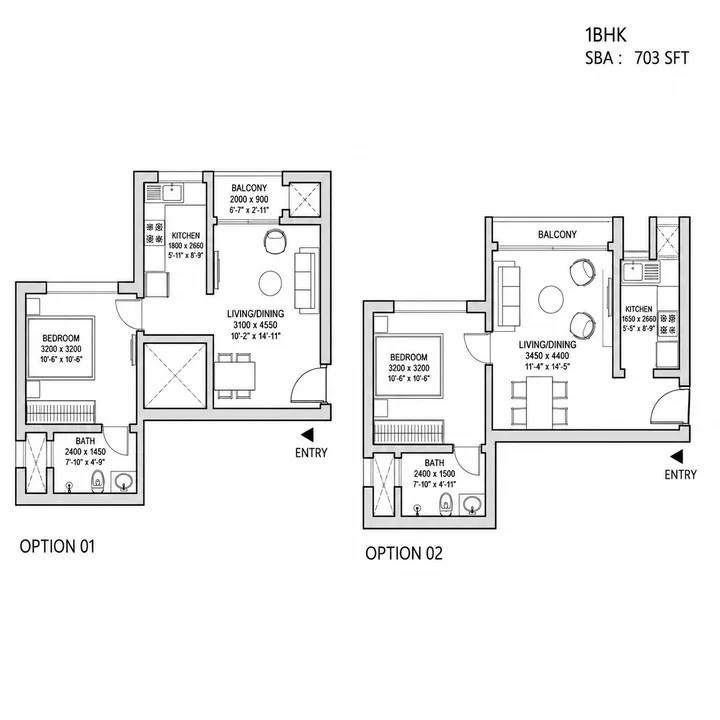
1 BHK
Verify bedroom width against a queen bed and wardrobe wall, balcony depth for seating, and whether the kitchen can hold a fridge and utility outside the cooking triangle. The plan must read as a complete home, not a studio with a partition.
From compact 1 BHK entry tickets to 4 BHK Grande family homes, with honest notes on loan size, resale, and tower-stack detail.
The Sobha OneWorld floor-plan decision should start with life stage, not with the largest unit the buyer can finance. The public plan mix covers seven working options: 1 BHK around 734 sq.ft., 2 BHK Small around 1,063 sq.ft., 2 BHK Large around 1,204 sq.ft., 3 BHK Lux around 1,510 sq.ft., 3 BHK Grande around 1,838 sq.ft., 4 BHK Lux around 2,096 sq.ft., and 4 BHK Grande around 2,415 sq.ft. Each size solves a different problem and attracts a different future buyer. In the same Bengaluru shortlist, Sobha Sacred Grove by the Lake helps readers think beyond unit size and ask whether the format actually supports the routine they are buying for.
A large township with more than 5,000 Phase 1 units can support many buyer profiles, but it also means resale competition will exist inside the project itself. When dozens of similar units are listed in the future, the plan that is easier to understand, furnish, rent, and maintain will get more attention. That makes layout efficiency, room proportions, balcony usability, kitchen utility, ventilation, lift distance, and floor position just as important as total square footage.
A good plan should pass three everyday tests. Can the living and dining area hold normal furniture without blocking balcony access or bedroom movement? Can the kitchen and utility handle cooking, laundry, and storage without spilling into the living space? Can bedrooms hold wardrobes, a work surface, and circulation without feeling cramped?
Buyers should also separate super built-up area from carpet area. Public launch material usually talks in super built-up terms because it is the common market language for price comparison. RERA documentation will disclose carpet area, and that number is the more useful indicator of usable internal area. A plan with a slightly lower super built-up size can be better than a larger plan if it wastes less space in passages, odd corners, or shallow balconies.
The neutral recommendation is to shortlist two sizes, not one. Pick a primary configuration that fits lifestyle and a fallback configuration that fits budget. Then compare all-in cost, EMI, pre-EMI, future resale audience, and furnishing practicality. If the primary choice feels exciting but fragile under cash-flow stress, the fallback may be the wiser home.
| Plan | Best-fit buyer | What to verify |
|---|---|---|
| 1 BHK 734 sq.ft. | Single professionals, investor entry, compact future city base | Bedroom width, wardrobe wall, balcony utility, rental audience, maintenance burden. |
| 2 BHK Small 1,063 sq.ft. | Couples, young families, buyers controlling ticket size | Room proportions, second bedroom usability, work-from-home space, storage. |
| 2 BHK Large 1,204 sq.ft. | Broadest family and rental fit | Living-dining width, kitchen utility, master bedroom comfort, balcony orientation. |
| 3 BHK Lux 1,510 sq.ft. | Families wanting a long-use home without 3 BHK Grande budget | Third bedroom size, study/maid-room wording, bathroom access, utility. |
| 3 BHK Grande 1,838 sq.ft. | Larger families and premium end users | Privacy, two-car parking terms, balcony depth, resale premium. |
| 4 BHK Lux 2,096 sq.ft. | Families needing four rooms with controlled premium ticket | Bedroom equality, staff/utility zone, storage, interior budget. |
| 4 BHK Grande 2,415 sq.ft. | Premium long-term family home | View, tower stack, lift core, privacy, high-floor cost, liquidity. |
The 1 BHK is the entry product, but it should not be dismissed as only a small unit. In a 48-acre Phase 1 township, a compact apartment can work for singles, NRIs wanting a Bangalore base, parents buying for a child, or investors who want the lowest Sobha ticket. The risk is that a crore-plus 1 BHK in Hoskote has a more limited end-user family audience. The rental and resale case depends heavily on the final township environment, connectivity by 2030, and whether young professionals accept Hoskote as a practical work base.
The 2 BHK Small is a budget discipline product. It may suit a couple or a young family that wants Sobha quality but does not want to cross into a large EMI. Its success depends on the second bedroom. If the second bedroom can function as a child’s room or workroom, the plan stays useful for longer. If it is too tight after wardrobe and bed placement, the buyer may outgrow it quickly.
The 2 BHK Large is likely to be the most liquid plan type for many buyers because it balances ticket size, family usability, and rental audience. A 1,204 sq.ft. 2 BHK can serve couples, small families, investor-landlords, and future resale buyers who want an efficient branded apartment without entering the 3 BHK budget band. For this plan, tower orientation and usable balcony position can become meaningful differentiators.
The 3 BHK Lux and 3 BHK Grande should be evaluated as long-stay homes. A 3 BHK buyer is often thinking about children, parents, guests, work-from-home, or simply not wanting to move again for a decade. The Lux version keeps cost lower but may require more compromises in room size and storage. The Grande version gives better comfort but raises all-in cost, interiors, and maintenance. Buyers should compare the incremental cost against the number of additional years the family can stay comfortably.
The 4 BHK Lux and Grande are lifestyle-led products. They may appeal to larger families, senior professionals, business owners, or buyers upgrading from an older East Bangalore apartment. The big risk is not usability; it is liquidity and carrying cost. Premium buyers are selective, and a future resale buyer at this ticket will care deeply about view, floor, tower reputation, parking, lobby experience, and maintenance. Choose the stack as carefully as the size.
Verify bedroom width against a queen bed and wardrobe wall, balcony depth for seating, and whether the kitchen can hold a fridge and utility outside the cooking triangle. The plan must read as a complete home, not a studio with a partition.
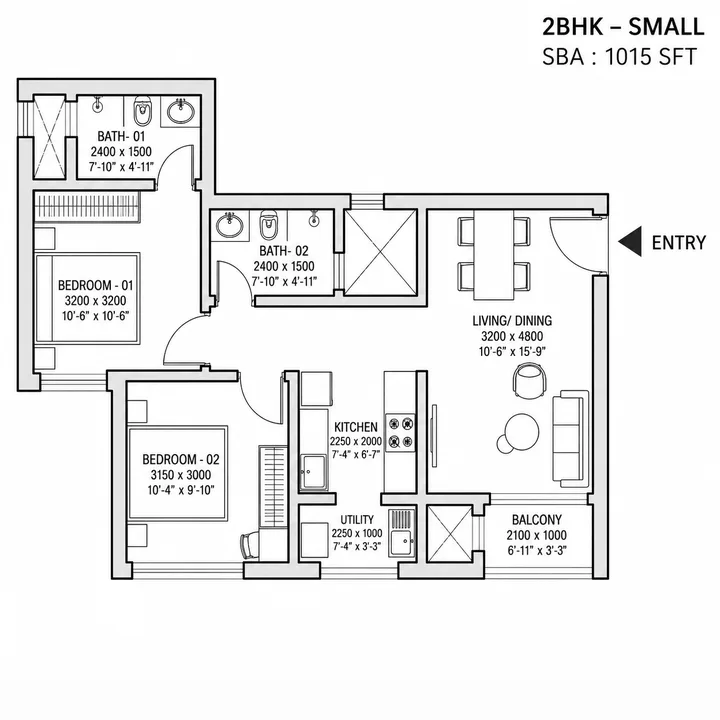
The discipline plan. Check the second bedroom against a single bed plus wardrobe plus study desk; if any one of the three has to go, the plan will age faster than the loan. Living-dining wall length and utility area are the second priority.
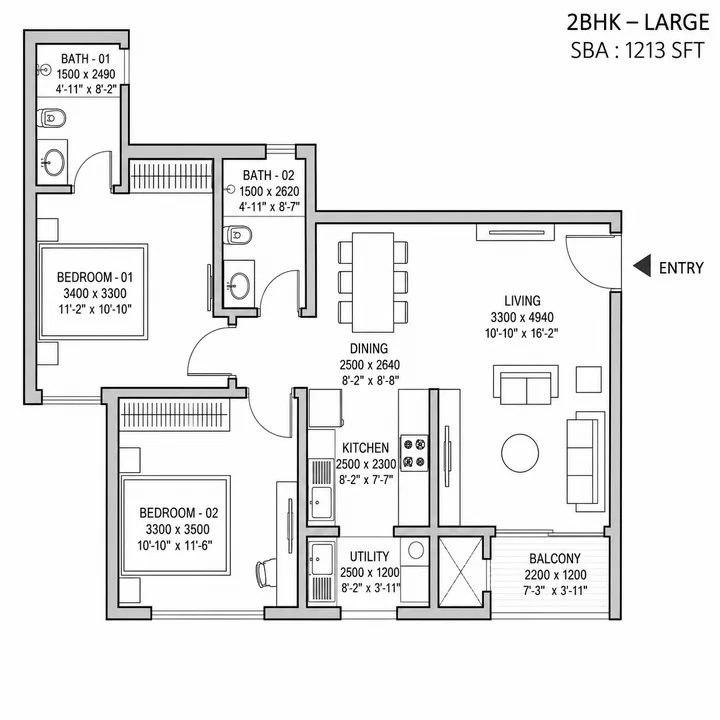
Likely the most liquid plan in the project. Compare the incremental ~140 sq.ft. over the Luxe against the price delta and ask whether it lands in the living-dining, master bedroom, or utility. Tower orientation matters more for this stack than for any other.
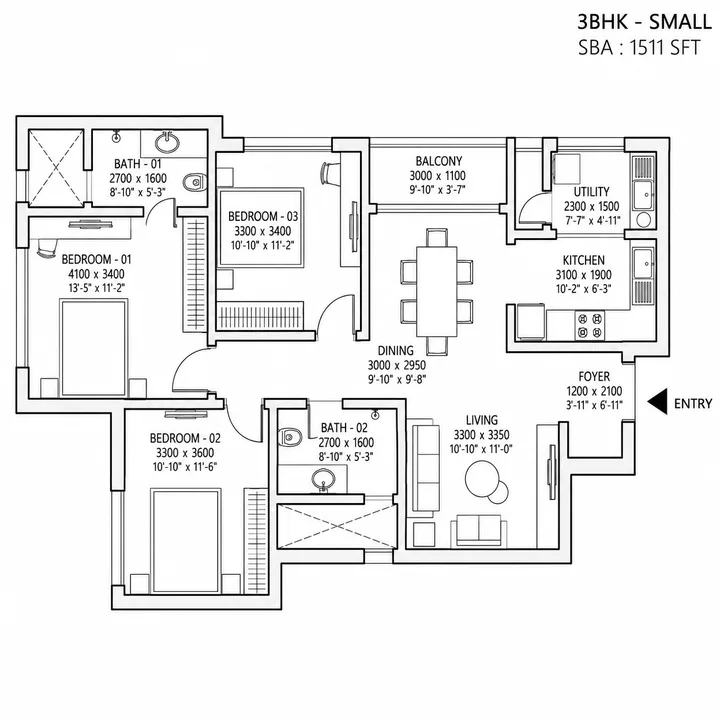
The compact three-bedroom. The third bedroom is the swing factor - ask whether it is a full bedroom or a study/maid-room labelled as one. Bathroom pairing and morning-rush circulation should be walked through before committing.
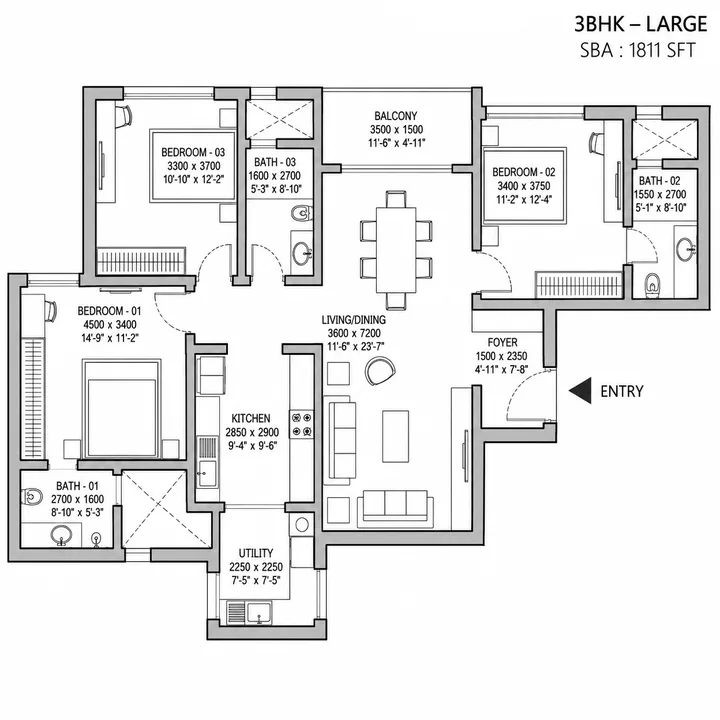
A long-stay family home. Confirm two-car parking terms in writing, balcony depth and orientation, and whether bedrooms are sized for adults rather than children. The extra area is only useful if it lands in furniture walls and storage, not corridors.
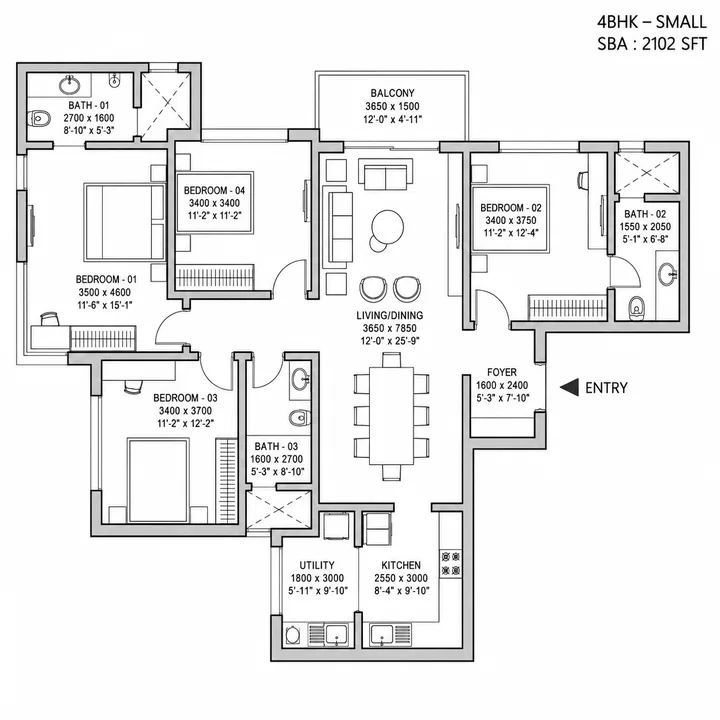
Four bedrooms with controlled premium. Check bedroom equality (no token room), the staff or utility zone, and whether the kitchen scales for daily four-bedroom cooking. Tower stack and view direction become a meaningful part of the price.
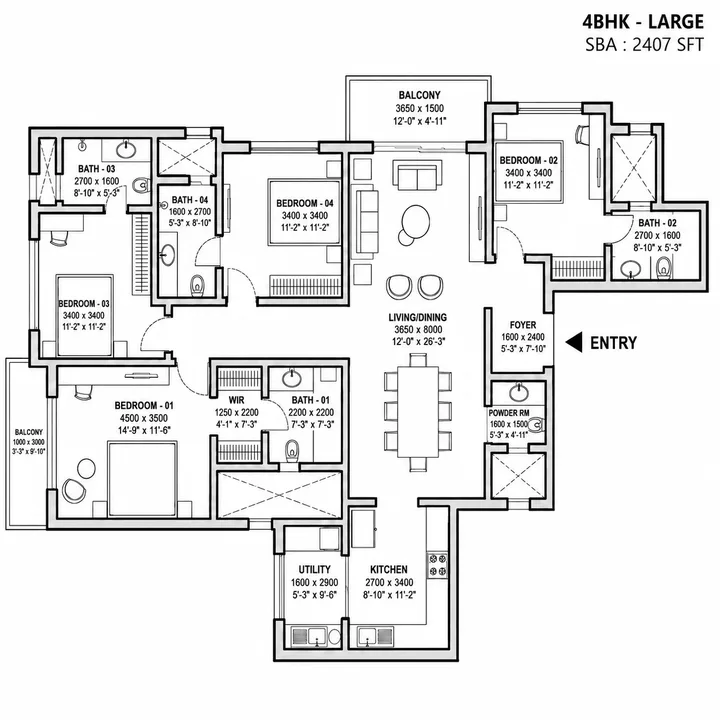
The premium family residence. Resale liquidity at this ticket depends on view, floor, lift core, parking, and lobby experience as much as on area. Treat it as a long-term end-use home rather than a tactical investment.
A 46-floor tower changes the floor-plan conversation. In a mid-rise project, the difference between the 7th and 14th floor may be mostly view and price. In a very tall tower, floor selection can affect waiting time for lifts, wind exposure, emergency comfort, heat, sound, view, floor-rise premium, and the buyer’s personal comfort with height. Some buyers love high floors; others feel better in the lower-middle bands where evacuation anxiety and lift dependence feel more manageable.
Tower selection should begin with the master plan. Ask where the tower sits relative to the main entry, central green, clubhouse, sports courts, service roads, visitor parking, school or retail parcels, STP/utility areas, and future phase construction. A tower that looks attractive in a launch stack may face years of neighbouring construction if later phases rise nearby. A tower facing the central green may command a premium, but buyers should verify whether the view remains protected after future phase planning.
Stack selection is where many buyers make rushed decisions. The same plan can feel different depending on orientation, sunlight, wind direction, road noise, and view corridor. East-facing and north-facing preferences are common in Bangalore, but practical comfort should come first. A harsh west-facing living room can increase heat load; a lower-floor unit facing a busy internal road can have noise; a high-floor unit near lift equipment or refuge levels may have different service considerations.
Lift planning is another key question in very tall residential towers. Buyers should ask how many passenger lifts and service lifts serve each core, whether there are fire lifts, how refuge areas are placed, and how maintenance access is managed. The answer belongs in the technical drawings and approval documents, not just in a sales explanation. A premium high-rise can still become frustrating if vertical circulation is under-designed for the number of homes served by the core.
Parking should be matched to the unit type and household reality. Larger 3 and 4 BHK buyers may need two car parks now or in the future. Smaller-unit buyers should check whether parking is included, optional, stack/tandem, basement level-specific, or charged separately. In a large township, the distance from basement bay to lift core matters for everyday life, especially for senior residents, children, and grocery runs.
The best practical method is to shortlist by stack after a site-plan review. First eliminate towers with obvious lifestyle conflicts. Then compare two or three stacks in the same configuration for view, sunlight, lift distance, floor premium, and likely resale appeal. Do not choose a unit only because it is “available now” or because the EOI priority window creates urgency.
Efficient 2 BHK and practical 3 BHK plans usually attract the widest future audience because they balance affordability and family usability.
3 BHK Grande and 4 BHK homes can deliver better end-use comfort, but they need stronger buyer income and more selective resale demand.
The 1 BHK controls entry cost but needs a clear rental or future-use thesis because family buyers may prefer 2 BHK plans.
Rental logic in 2031 will not be the same as rental logic in 2026. Today, Hoskote rents are still lower than mature Whitefield-side locations. By possession, the township may command a brand and amenity premium, but the rent still has to compete with the distance from offices, metro access, school preference, and the amount of competing supply in Hoskote and Budigere. This is why the floor-plan decision should not be made on optimistic rent alone.
For investors, the 2 BHK Large is often the cleanest thesis because it has a broad tenant and resale pool. It can work for a couple, small family, or two working professionals. The 2 BHK Small may deliver a better yield percentage if ticket size stays lower, but only if the layout does not feel compromised. The 1 BHK can work if the township becomes a strong rental ecosystem, but the buyer should be comfortable with potentially slower resale compared with mainstream 2 BHK demand.
For end users, resale should still matter because life changes. A family may relocate, need a larger home, or decide Hoskote is too far after possession. Pick a plan that another rational buyer can understand quickly. Odd room shapes, poor furniture walls, weak utility space, or a compromised second/third bedroom can become negotiation points later. A beautiful clubhouse cannot fully compensate for a home that is hard to furnish.
For premium 4 BHK buyers, the resale audience is smaller but more quality-conscious. A future buyer at that ticket size may compare villas, row houses, premium resale apartments, and larger homes in more central areas. The plan must therefore offer a genuine lifestyle reason: views, privacy, room size, storage, staff/utility management, parking, and tower prestige. If the premium is only area, the resale case is weaker.
The conclusion is simple: choose a plan that works without perfect market conditions. If appreciation is strong, any sensible plan benefits. If the market is selective, efficient and comfortable plans hold attention better. Floor-plan discipline is one of the few risks the buyer can control at booking stage.
A buyer can learn a lot by walking through a floor plan mentally from the entrance. The foyer should not open awkwardly into the dining table or expose private bedroom doors immediately. The living and dining area should have enough wall length for sofa, television, dining, and circulation. The balcony should be reachable without cutting through furniture. These details matter because a plan that looks good as an outline can become frustrating after furniture is placed.
Bedroom evaluation should be practical. Ask where the bed goes, where wardrobes go, whether there is a study desk wall, how doors swing, whether the window placement affects furniture, and whether two people can move comfortably. For children’s rooms, check whether the room can handle a bed, wardrobe, study table, and play/storage needs. For parents or guests, check bathroom access and privacy.
Kitchen and utility planning can make or break daily life. A premium buyer should not accept a kitchen that has weak counter length, poor ventilation, or a utility that cannot handle washing machine, drying, cleaning supplies, and gas or service access. If the family cooks daily, the kitchen is not a small service corner; it is one of the most-used spaces in the home.
Bathrooms and circulation should be checked against morning rush. In a 2 BHK, two bathrooms are useful only if access is sensible. In a 3 BHK, bedroom-bathroom pairing affects privacy. In a 4 BHK, guest access, children’s access, and senior access all matter. Also check whether corridors waste area or create useful separation. Some circulation is good for privacy; too much becomes paid but unusable space.
Balcony and view should be checked by stack. A balcony facing a central green or open corridor can improve daily life and resale. A balcony facing another tower too closely may be less valuable, even if the plan has the same area. Ask for tower spacing and orientation. Ask whether AC outdoor units, service ledges, or safety grills affect the balcony experience.
The room-by-room method helps buyers avoid upgrade regret. Many buyers stretch for a larger plan because it sounds safer, but a well-designed smaller plan can be more livable than a larger plan with wasted areas. Conversely, some compact plans are too tight for long-term family use. The right answer comes from furniture, routine, storage, and budget, not from area alone.
Sketch bed, wardrobe, sofa, dining, work desk, TV, and appliances before selecting the stack.
Imagine two adults, one child, school prep, breakfast, laundry, and work calls happening at once.
Ask whether another buyer can understand the plan’s value quickly without needing special explanation.
Request both the marketing floor plan and the RERA carpet-area disclosure when available. Marketing plans help with room relationships and furniture thinking; RERA disclosures help with usable-area clarity. If a sales conversation uses super built-up area and a legal document uses carpet area, the buyer should understand the efficiency ratio rather than assuming both numbers describe the same thing.
Ask for the unit plan with dimensions, not only a clean brochure image. Dimensions reveal whether a bedroom can take a queen bed and wardrobe, whether the dining area is truly usable, whether the balcony is deep enough for seating, and whether the kitchen has adequate counter length. A plan without dimensions is useful for orientation but weak for purchase decisions.
Ask for the floor plate. The individual plan does not show how the unit sits relative to lifts, fire stairs, service shafts, neighbouring doors, refuge areas, and corridor ends. A good unit can feel less private if its entrance faces a busy lift lobby. A slightly smaller unit can feel better if it has calmer access, better light, and stronger view direction.
Ask for the stack plan. The same unit repeated vertically can have different appeal depending on floor, obstruction, neighbouring tower, podium, road, central green, or utility view. If the buyer is paying a floor-rise or view premium, the stack plan is essential. Do not pay for “open view” without seeing what future phases may place in that direction.
During the model-flat visit, carry a checklist. Mark what is included in handover, what is an upgrade, what is loose furniture, what is interior treatment, and what is only styling. Check switch placement, wardrobe walls, kitchen appliance space, bathroom ventilation, balcony railing height, AC outdoor unit placement, and whether the utility can handle drying clothes.
After the visit, compare notes with budget. A plan that needs expensive custom interiors to become usable may not be as efficient as it first appeared. A plan with clean furniture walls and good storage can save interior cost and improve resale. Floor-plan value is partly architectural and partly financial.
A practical way to use this floor-plan page is to turn it into a meeting agenda. Instead of asking the sales team broad questions such as whether the project is good, ask for the exact dimensions, stack, view, lift distance, and furniture fit details that affect your decision. Specific questions get specific answers, and specific answers are easier to compare with documents later.
Keep a written version history. Launch-stage projects change quickly: pricing slabs move, tower availability changes, RERA documents appear, payment schedules are refined, and amenity phasing becomes clearer. When you receive an answer, record the date, person, document name, and whether the answer came from a brochure, email, cost sheet, RERA upload, or verbal discussion.
Do not treat the first available unit as the only opportunity. Large projects often create urgency through EOI windows and preferred-unit availability, but the buyer still needs to check whether that unit fits budget, routine, floor preference, view, and resale logic. A less glamorous unit that fits the decision framework can be better than a rushed premium unit.
The key document for this page is the dimensioned unit plan, floor plate, and tower stack plan. If that document is not yet available or does not answer the question clearly, mark the item as pending rather than resolved. Pending items do not always mean “do not buy.” They mean the buyer should avoid converting interest into a binding commitment until the uncertainty is proportionate to the amount being paid.
Every Sobha OneWorld decision also has an opportunity cost. The same budget may buy a smaller but more mature Whitefield resale, a different branded Hoskote launch, a Budigere Cross apartment, a North Bangalore option, or a lower-risk ready home. The floor-plan decision is stronger when the buyer can explain why Sobha OneWorld remains preferable after those alternatives are honestly considered.
The final floor-plan takeaway is that the best plan is the one that stays usable, liquid, and affordable rather than simply the largest area available. If that trade-off is acceptable, the next step is to compare two shortlisted configurations against all-in cost and daily-use comfort. If it is not acceptable, the buyer should pause, collect more evidence, or compare a different configuration or location before paying further.
Pricing is the item that least survives a move between markets, so treat any cross-city read as developer context and nothing more.
Seven floor plans are on the brochure: 1 BHK (734 sq.ft.), 2 BHK Luxe (1,063 sq.ft.), 2 BHK Grande (1,204 sq.ft.), 3 BHK Luxe (1,510 sq.ft.), 3 BHK Grande (1,735–1,838 sq.ft.), 4 BHK Luxe (2,096 sq.ft.), and 4 BHK Grande (2,415 sq.ft.). All areas are saleable built-up area.
Luxe variants are the more compact saleable-area option within each BHK count, while Grande variants offer larger living and master-bedroom proportions. For example, the 2 BHK Luxe at 1,063 sq.ft. compares to the 2 BHK Grande at 1,204 sq.ft., and the 4 BHK Luxe at 2,096 sq.ft. compares to the 4 BHK Grande at 2,415 sq.ft.
The 734 sq.ft. 1 BHK is the lowest ticket size, suitable for singles, NRIs, parents buying for a child, or compact-investor formats. Its long-term resale and rental audience is narrower than a 2 BHK, so weigh ticket size against future buyer base and Hoskote rental absorption before choosing.
The 2 BHK Grande (1,204 sq.ft.) and 3 BHK Luxe (1,510 sq.ft.) typically pass the furniture and routine test for couples and small families. Larger 3 BHK Grande (1,735–1,838 sq.ft.) and 4 BHK Luxe / Grande (2,096–2,415 sq.ft.) suit long-stay families with stronger income stability.
All seven figures on the brochure are saleable built-up area, which includes wall thicknesses and a proportion of common areas. The RERA carpet area for each unit will be lower and is the regulator-recognised measurement; insist on seeing the RERA carpet area alongside saleable area in the cost sheet.
Floor-plate drawings, internal dimensions, balcony depth, utility size, and electrical points are detailed in the official Sobha OneWorld brochure dated 9 May 2026 and the per-wing layouts shared at the sales office. Ask for the exact stack-wise plan for the tower and floor you are considering.