Legal risk
Mitigate by waiting for RERA details, matching phase/tower/unit to documents, and using an independent lawyer before AOS.
How Sobha One World stacks up in Hoskote and East Bangalore, and what to verify before you book.
Sobha One World should not be compared only with other Hoskote projects. A buyer in the ₹1.09-3.9 Cr range is also comparing Budigere Cross, Whitefield resale, Panathur, KR Puram, Sarjapur Road, North Bangalore, and sometimes villa or plotted options. The correct comparison depends on what the buyer values most: developer brand, possession timeline, commute, social infrastructure, floor-plan size, rental yield, or long-term appreciation.
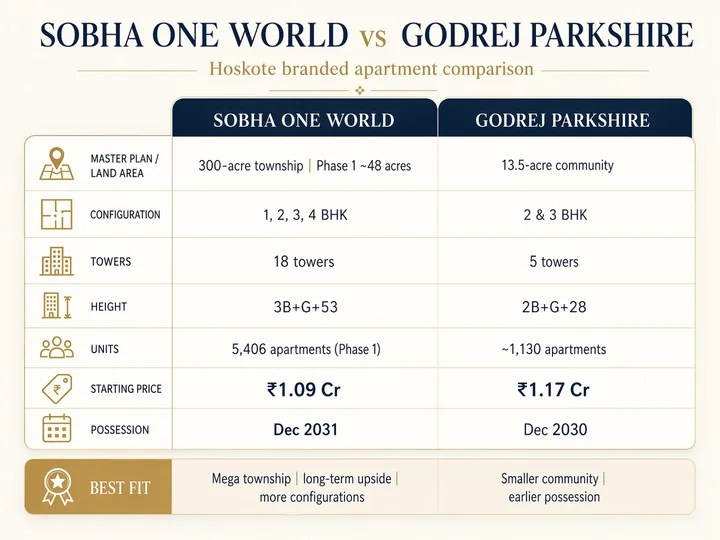
The closest named comparison is Godrej Parkshire in Hoskote. Public RERA-oriented pages describe it as a 13.5-acre project with 5 towers, about 1,130 homes, 2 and 3 BHK configurations, and a December 2030 possession timeline. Sobha One World is much larger, with a 300-acre township story and 48-acre Phase 1 narrative, but it also has a longer target possession date and an awaited RERA status in the current public notes. That makes the comparison less about good versus bad and more about scale versus certainty.
Budigere Cross projects such as Godrej Woodscapes or Bengal Lamps sit in a slightly different maturity band. They may offer earlier possession and stronger existing social infrastructure access compared with deeper Hoskote, while still remaining within East Bangalore’s growth orbit. Whitefield resale offers the strongest present-day ecosystem but usually at a higher entry cost or with older inventory. North Bangalore may offer airport-side growth but different office-catchment logic.
Sobha One World’s edge is the combination of Sobha brand, large township identity, Hoskote early-entry thesis, and broad unit mix. Its caution points are RERA timing, 2031 possession, construction-period cash flow, water verification, and the reality that Hoskote is not yet a mature premium lifestyle location. A buyer should explicitly decide whether they are paying for today’s convenience or tomorrow’s upside.
A neutral advisory conclusion starts here: Sobha One World is strongest when judged as a long-horizon township bet, not as a quick-yield apartment. Buyers who evaluate it against the wrong set may either overpay emotionally or dismiss it too quickly. The correct comparison is risk-adjusted: what else can this budget buy, how soon can it be used, how mature is the location, and how much upside remains?
| Choice | Strength | Trade-off |
|---|---|---|
| Sobha One World, Hoskote | Largest township-scale story, Sobha quality perception, 1-4 BHK range, long-term Hoskote upside | RERA awaited in current notes, 2031 target, large supply, Hoskote maturity risk. |
| Godrej Parkshire, Hoskote | RERA-approved reference, smaller 13.5-acre community, 2030 possession timeline, Godrej brand | Less township scale, mainly 2 and 3 BHK focus, different density and amenity context. |
| Budigere Cross branded launches | More established East Bangalore residential cluster, earlier possession options, closer to some Whitefield-side routines | May have less dramatic early-entry upside and different pricing/availability. |
| Whitefield resale / mature projects | Established schools, offices, metro, retail, rental depth, immediate usability | Higher cost, older inventory, lower future-growth surprise, possible maintenance age. |
| North Bangalore alternatives | Airport-side infrastructure and large township/villa options | Different work-catchment logic for East Bangalore employees. |
| Villa / plotted alternatives | More land control and lower vertical-density concerns | Usually weaker amenities, maintenance, security, or commute depending on project. |
Godrej Parkshire is useful because it gives a same-micro-market branded benchmark. If a buyer wants Hoskote but prefers a smaller community and a RERA-approved reference in current public materials, Godrej Parkshire deserves evaluation. If the buyer wants the largest township ecosystem and is willing to wait longer, Sobha One World becomes more compelling. The decision should not be made on brand alone because both developers are serious national players.
Budigere Cross provides a maturity benchmark. It has seen more residential clustering, retail activity, and branded launches over recent years. A buyer who wants East Bangalore growth but is less comfortable with Hoskote’s current ecosystem may find Budigere more balanced. The trade-off is that the value-entry point may not be as early, and available inventory may have different floor plans, density, or pricing.
Whitefield resale is the convenience benchmark. It offers metro access, office proximity, stronger rentals, schools, malls, hospitals, and established resident networks. But buyers may face older buildings, smaller open spaces, higher price per square foot, and less township-scale green planning. A buyer choosing Sobha One World over Whitefield is usually choosing future township scale over present-day convenience.
North Bangalore and Sarjapur comparisons are useful for budget discipline. At ₹2-4 Cr, buyers have choices across the city. If the buyer’s workplace, family, and lifestyle are not tied to East Bangalore, Sobha One World should compete against other corridors honestly. If the buyer’s life is East-side, the Hoskote-Whitefield-Budigere comparison matters more.
The best comparison habit is to score each option across five axes: commute today, location maturity today, possession timeline, developer/project confidence, and upside by 2031-2035. Sobha One World scores well on developer confidence and upside potential, moderately on current location maturity, and requires caution on timeline and cash flow.
Mitigate by waiting for RERA details, matching phase/tower/unit to documents, and using an independent lawyer before AOS.
Mitigate with all-in cost, rent plus pre-EMI planning, emergency corpus, and conservative loan assumptions.
Mitigate by testing routes, school access, hospital access, night-time safety, and Hoskote services before booking.
Mitigate by asking for source mix, storage, STP capacity, tanker backup, and Cauvery-readiness in writing.
Mitigate by confirming which amenities and roads are delivered with Phase 1 and how later construction is separated.
Mitigate by choosing liquid configurations, strong stacks, sensible all-in price, and a holding period beyond possession.
Legal risk is the easiest to reduce because it has a clear process. Do not rely only on public pages or sales conversations. Once RERA is available, verify the project name, promoter, phase, land extent, tower, apartment inventory, carpet area, completion date, approvals, and project bank account. Then compare the Agreement of Sale with those disclosures. If the project is still in EOI stage, treat the payment as a refundable expression of interest unless written terms say otherwise.
Financial risk is the risk buyers most often underestimate. A household may qualify for a loan and still feel stressed if rent plus pre-EMI runs for years. The right mitigation is a conservative budget: all-in cost, interior cost, moving cost, emergency fund, and a stress scenario where income growth is slower than expected. If the purchase works only under optimistic assumptions, reduce configuration size or wait for more clarity.
Location risk is personal. Hoskote can be good for one buyer and poor for another depending on workplace, school, family support, driving comfort, and weekend habits. The only honest solution is route testing. Drive at your actual office time. Check school transport. Visit at night. Talk to residents nearby. Compare Hoskote with Budigere and Whitefield using the same routine, not only the same price.
Water risk needs written answers. A 300-acre township may have better planning capacity than smaller projects, but scale also creates huge demand. Buyers should ask about borewells, storage, STP, treated water, tanker backup, and Cauvery Stage VI readiness. If the answer is vague, mark it as a follow-up condition before AOS.
Phasing risk comes from the gap between vision and delivery. Early towers may be handed over while later towers, roads, or amenities are still under construction. Ask for a handover sequence. Ask which amenities are usable with first possession. Ask how residents are protected from future construction movement.
Resale risk is managed at the time of purchase. Do not overpay for a weak stack. Do not choose an odd plan because it is the only one available. Do not assume future buyers will ignore commute or water questions. The most resilient resale units are usually efficient, well-priced, well-oriented, and easy for another buyer to understand.
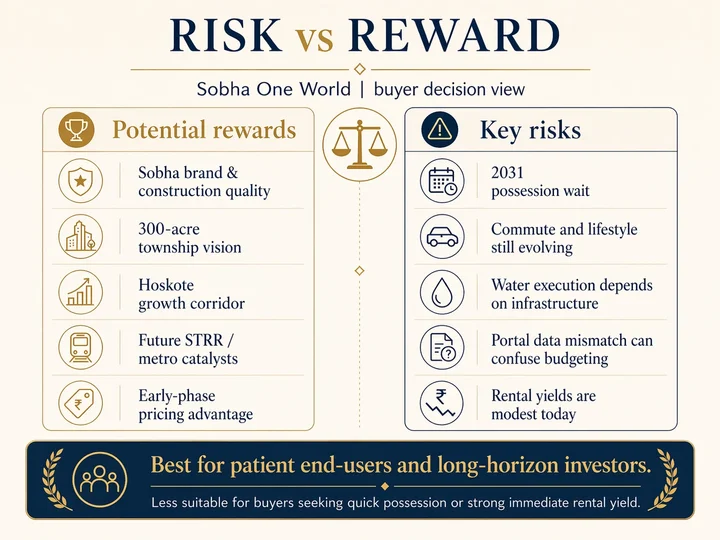
The strongest-fit end user is a family with East Bangalore routines, stable income, and a long holding period. They may currently rent near Whitefield, KR Puram, Kadugodi, or ORR, but want a newer township and are willing to wait until 2031. They are not expecting immediate rental yield. They are buying a future home and can tolerate construction-period payments without compromising emergency savings.
The strongest-fit investor is patient and document-driven. This buyer understands that Hoskote’s appreciation story depends on infrastructure, residential clustering, and Sobha delivery. They are comfortable holding beyond possession, choosing a liquid configuration, and accepting that rent may not justify EMI initially. They use launch pricing only if the all-in cost leaves enough margin against future competition.
The cautious-fit buyer likes Sobha and Hoskote but has unresolved questions about school access, water, RERA, or budget. This buyer should not reject the project automatically, but should slow the process. Wait for RERA, ask for documents, compare Godrej Parkshire and Budigere options, and run a full cost model. If the project still wins after that, the decision becomes stronger.
The weak-fit buyer needs possession soon, wants immediate rental income, has a tight budget, or dislikes long commutes. This buyer may be happier with a ready or near-ready resale unit in a mature location, even if it has less brand-new shine. A beautiful future township does not solve present-day urgency.
NRIs and remote investors need extra caution. They may like the brand and the long-term corridor story, but they need local document support, site monitoring, rental management planning, and a realistic view of resale liquidity. A large launch can be attractive, but remote buyers should avoid buying only through presentation decks and video calls.
The final advisory language is deliberately moderate: move forward if the project fits your life, not just your aspiration. Sobha One World can be a strong long-term choice, but the right buyer is patient, financially prepared, and willing to verify every major claim before paying serious money.
A final shortlist should convert feelings into a scorecard. Sobha One World may feel impressive because of brand, scale, and launch energy. A scorecard makes the buyer test whether that impression survives practical comparison. The scorecard should include developer confidence, legal clarity, all-in cost, construction-period affordability, commute, school/healthcare fit, water confidence, floor-plan efficiency, amenity value, and resale liquidity.
Developer confidence is a relative strength for Sobha. The company’s Bangalore reputation and FY26 sales performance support trust. Give that category a strong score if the buyer values quality and brand. But do not allow developer confidence to automatically raise legal clarity. Legal clarity should be scored only after RERA, sanctioned plans, phase details, and agreement terms are verified.
Cost should be scored on the livable number, not the base number. A buyer who rates the project highly at ₹1.77 Cr but weakly at ₹2.25 Cr has discovered the real decision point. Use all-in cost, EMI, pre-EMI, interiors, and maintenance estimates. A project can be excellent and still be wrong for a household if it consumes too much monthly flexibility.
Location should be scored through routine, not reputation. Give points only for routes actually tested or services actually verified. If Whitefield access works at the buyer’s office time, that is a real strength. If the buyer is assuming future metro or future retail, that should be scored as possible upside, not current convenience.
Water and infrastructure should be scored with evidence. Cauvery Stage VI improves the macro story, but project-level water planning still needs documents. STRR and expressway narratives support appreciation, but the buyer’s daily movement depends on actual access. Distinguishing macro upside from current usability keeps the scorecard honest.
Resale liquidity should be scored by configuration and entry price. A well-priced 2 BHK Large in a good stack may score higher than a stretched premium unit in a weaker view. A 4 BHK may score high for lifestyle but lower for liquidity. This does not make one better than the other; it clarifies what kind of buyer you are.
After scoring, compare the top two alternatives. If Sobha One World wins by a narrow margin but has unresolved RERA or water questions, wait for documents. If it wins clearly and the household can carry the cost conservatively, proceed to legal and financial verification. If it loses on routine and budget but wins emotionally, pause. Emotional fit is important, but it cannot carry a five-year construction commitment alone.
| Score area | Sobha One World question | Decision signal |
|---|---|---|
| Developer | Do you value Sobha quality enough to wait for this township? | Strong if brand and finish matter deeply. |
| Legal | Is RERA and phase scope verified? | Weak until documents are checked. |
| Cost | Does all-in price remain comfortable under stress? | Strong only with rent plus pre-EMI buffer. |
| Location | Does your actual weekly routine work? | Strong only after route testing. |
| Water | Is the source plan written and credible? | Weak if answer remains generic. |
| Resale | Is the chosen plan liquid and sensibly priced? | Strong for efficient mainstream plans. |
Before booking, write down the exact alternative you would buy if Sobha One World were unavailable. This is a powerful test. If the alternative is Godrej Parkshire, the buyer values Hoskote but wants a different scale/timeline. If the alternative is Budigere, the buyer values East Bangalore but wants more maturity. If the alternative is Whitefield resale, the buyer values convenience over future upside. If there is no alternative, the buyer may be making an emotional decision rather than a comparative one.
Check whether the preferred configuration is still attractive after all-in cost. If the 3 BHK was exciting at base price but uncomfortable after registration, GST, charges, interiors, and pre-EMI, the correct advisory answer may be to step down to a 2 BHK Large or wait. A good purchase should feel slightly stretched at most, not financially breathless.
Check whether the household agrees on Hoskote. One family member may love the township while another worries about commute, schools, or social life. These concerns should be discussed before EOI. A home bought for five or ten years needs shared conviction, not only one person’s investment thesis.
Check whether the project answers are documented. RERA status, phase plan, water plan, payment schedule, cancellation terms, and cost sheet should move from verbal to written before the commitment becomes serious. Verbal comfort is useful for early exploration; written clarity is required for booking.
Check whether you can hold through slower appreciation. If Hoskote prices rise strongly, the investment story looks easy. If growth is slower for three years, the buyer must still be comfortable owning the home. A long-term asset should not depend on perfect market timing.
The final advisory answer can be summarized as proceed, pause, or pass. Proceed if documents, budget, commute, and configuration align. Pause if the project is attractive but RERA, water, or cost clarity is pending. Pass if the location does not fit your life or the purchase requires financial optimism. This framework keeps the verdict neutral and buyer-specific.
A practical way to use this advisory page is to turn it into a meeting agenda. Instead of asking the sales team broad questions such as whether the project is good, ask for the exact comparison, risk score, red lines, and proceed/pause/pass criteria details that affect your decision. Specific questions get specific answers, and specific answers are easier to compare with documents later.
Keep a written version history. Launch-stage projects change quickly: pricing slabs move, tower availability changes, RERA documents appear, payment schedules are refined, and amenity phasing becomes clearer. When you receive an answer, record the date, person, document name, and whether the answer came from a brochure, email, cost sheet, RERA upload, or verbal discussion.
Do not treat the first available unit as the only opportunity. Large projects often create urgency through EOI windows and preferred-unit availability, but the buyer still needs to check whether that unit fits budget, routine, floor preference, view, and resale logic. A less glamorous unit that fits the decision framework can be better than a rushed premium unit.
The key document for this page is a side-by-side shortlist sheet with documents attached for each option. If that document is not yet available or does not answer the question clearly, mark the item as pending rather than resolved. Pending items do not always mean “do not buy.” They mean the buyer should avoid converting interest into a binding commitment until the uncertainty is proportionate to the amount being paid.
Every Sobha One World decision also has an opportunity cost. The same budget may buy a smaller but more mature Whitefield resale, a different branded Hoskote launch, a Budigere Cross apartment, a North Bangalore option, or a lower-risk ready home. The advisory decision is stronger when the buyer can explain why Sobha One World remains preferable after those alternatives are honestly considered.
The final advisory takeaway is that Sobha One World can be a strong candidate without being the right answer for every buyer or every budget. If that trade-off is acceptable, the next step is to choose only after comparing it with the best realistic alternative, not with a weak placeholder. If it is not acceptable, the buyer should pause, collect more evidence, or compare a different configuration or location before paying further.
The right advisory answer can change as documents arrive. Before RERA, a cautious buyer may pause. After RERA, if the phase, plans, price, and water answers are clear, the same buyer may proceed. If the final cost sheet is higher than expected, a buyer who was ready to proceed may step down in size or compare alternatives again.
This is why the decision should be staged. Use EOI only if the terms are comfortable. Use RERA and cost sheet to decide whether to convert interest into booking. Use legal review and bank sanction to decide whether to sign the Agreement of Sale. Each stage should reduce uncertainty rather than simply deepen emotional commitment.
A good advisory process also accepts that “not now” can be a valid outcome. Waiting for more clarity may reduce unit choice, but it can protect a buyer whose budget, commute, or legal comfort is not ready. The best real estate decision is not always the earliest one; it is the one the buyer can defend after the excitement fades.
The notes below are the compact public source trail used for this page. Project figures remain provisional until matched against the latest developer documents, Karnataka RERA listing, sanctioned plans, and signed price sheet.